Inside the PoA Module: Permissioned Consensus Without Token Overhead

Most Cosmos chains start with Proof-of-stake (PoS) consensus, and that’s still the right choice for many networks. But if you’re running a regulated environment, a consortium chain, or an enterprise network with known operators, PoS can create unnecessary overhead.
That’s why we built the Proof-of-authority (PoA) module: a first-class, native governance option written and maintained by the team behind the Cosmos stack. While PoS systems use staked tokens to secure the network, a PoA chain relies on a set of permissioned validators.
This design comes with some unique advantages:
- Network configurability: A configurable admin authority lets your selected administrator define operators and governance participants to satisfy security, compliance, and operational requirements.
- Token-free operation: Launch and govern a production network without the legal or operational complexity of creating or managing a native staking token.
- Future-proofed design: Move to other security models later to adapt to changing business needs, including to standard proof-of-stake with a token. Cosmos Labs can provide support when you are ready.
In practice, PoA also improves operational control and auditability. Every validator-power change, key rotation, and governance action is executed through explicit, administrator-controlled on-chain messages, creating a clear history for internal security reviews and external compliance audits.
How it Works
Before diving into PoA behavior, it helps to zoom out and look at how a Cosmos chain is put together. The Cosmos SDK is basically a set of plug-in modules: one for accounts, one for balances, one for governance, and so on, all coordinated by the app runtime. The PoA module is a direct replacement for x/staking, which is used for PoS systems.
In PoA, validators are managed by an administrator account. This could be any address, including the governance address, a multisignature wallet or even a smart contract.
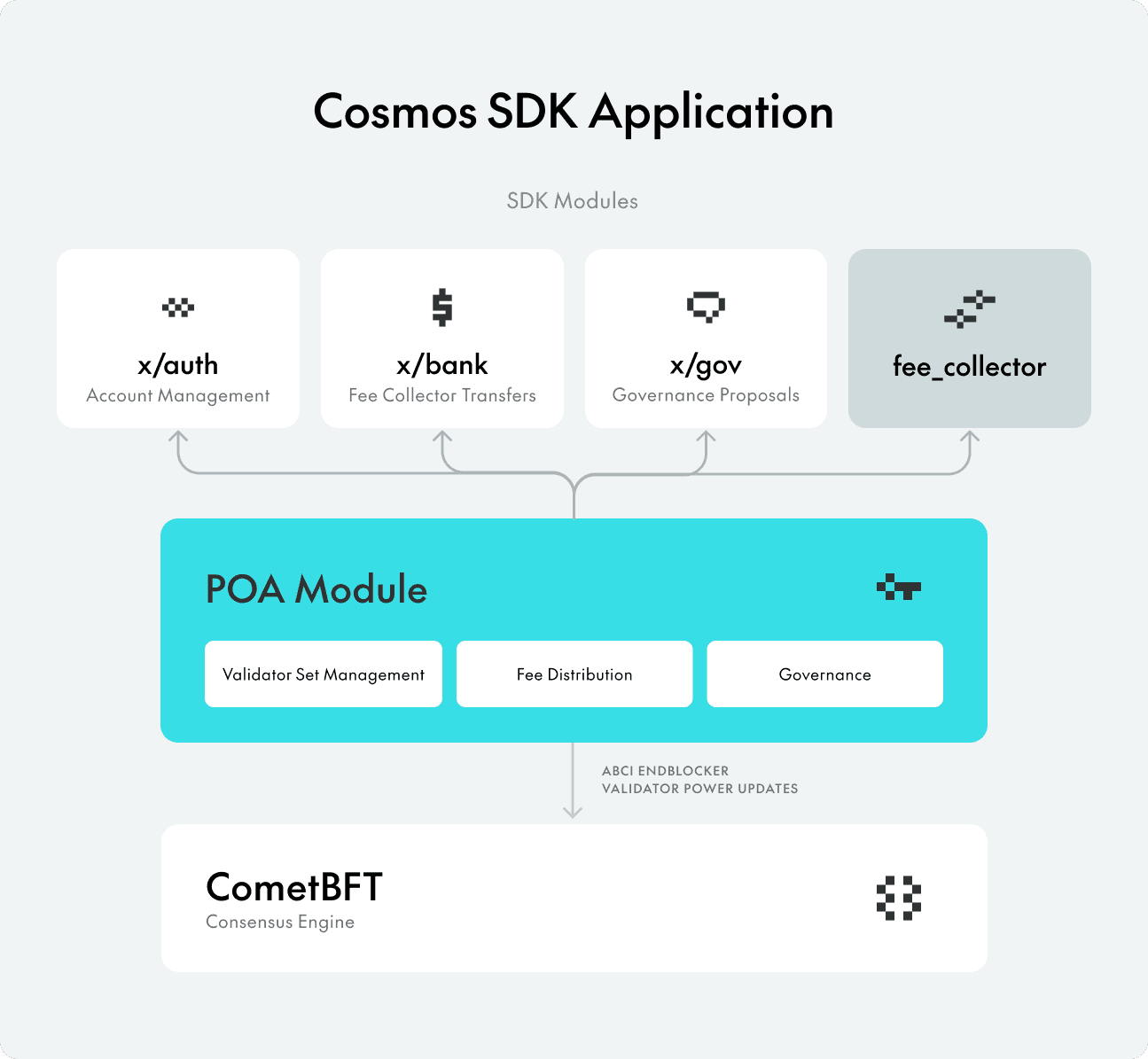
Flow
At a high level, PoA runs with three deterministic flows: validator management, authority-weighted governance, and fee distribution.
1) Validator Management
Any account can register as a validator candidate, but candidates start at power 0 and do not participate in consensus. An authorized admin updates the active set using MsgUpdateValidators, which can add, remove, replace, reweight, or rotate validator keys in a single transaction.
At EndBlock, the module commits the updated validator set to CometBFT. This makes set transitions atomic and predictable at block boundaries.
- Set power > 0: validator becomes active
- Set power = 0: validator is removed from consensus but remains on record for future reactivation
2) Governance by Validator Power
PoA governance is authority-weighted, not token-weighted. Only active validators (power > 0) can submit proposals, deposit, and vote. Tallying weight directly to validator power, including weighted vote splits. This keeps governance aligned with the same authority model that secures consensus.
3) Fee Distribution via Checkpoints
Fees accumulate in fee_collector and are allocated using checkpoint-based accounting.
Checkpoints are triggered when:
- validator power changes, or
- a validator withdraws rewards
This design avoids per-block distribution overhead while preserving fair rewards across validator set transitions.
Why it Matters
PoA gives teams explicit on-chain authority, fast validator-set updates, and predictable economics without requiring a staking token at launch. This reduces early operational risk by making validator and governance changes deterministic, auditable, and easy to map to compliance processes.
And if business needs change, the PoA module keeps a clean upgrade path to PoS later, so networks can decentralize further without rewriting core application logic.
Get Started with Proof-of-Authority
Contact institutions@cosmoslabs.io to learn more about how you can use the PoA module for your chain.
Further resources:
- Technical docs: PoA Documentation
- Source code: Cosmos SDK PoA Module Source Code